Question 61
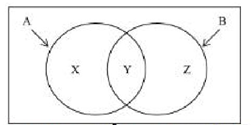
Consider the diagram given below and the following two statements:
View Dynamic Solution & Explanation ▼
Step-by-step Solution:
Statement II
Statement II: Events \( A \) and \( B \) can be expressed as:
\[
A = X - Y \quad \text{and} \quad B = Y + Z
\]
1. Expression for \( A \):
- \( X \) represents the part of \( A \) that is not in \( B \).
- \( Y \) represents the part of \( A \) that is also in \( B \).
- Thus, \( A = X - Y \) is false because \( X - Y \) would represent the part of \( A \) that is not in \( B \), but \( A \) should include both \( X \) and \( Y \).
2. Expression for \( B \):
- \( Y \) represents the part of \( B \) that is also in \( A \).
- \( Z \) represents the part of \( B \) that is not in \( A \).
- Thus, \( B = Y + Z \) is true because \( Y + Z \) represents the entire set \( B \).
Conclusion: Statement II is false because the expression for \( A \) is incorrect.
Statement I
Statement I: Events \( A \) and \( B \) can be expressed as:
\[
A = (A \cap \overline{B}) \cup Y \quad \text{and} \quad B = (A \cap B) \cup Z
\]
1. Expression for \( A \):
- \( A \cap \overline{B} \) represents the part of \( A \) that is not in \( B \).
- \( Y \) represents the part of \( A \) that is also in \( B \).
- Thus, \( A = (A \cap \overline{B}) \cup Y \) is true.
2. Expression for \( B \):
- \( A \cap B \) represents the part of \( B \) that is also in \( A \).
- \( Z \) represents the part of \( B \) that is not in \( A \).
- Thus, \( B = (A \cap B) \cup Z \) is true.
Conclusion: Statement I is true.
Final Conclusion
- Statement I: True
- Statement II: False