Question 39
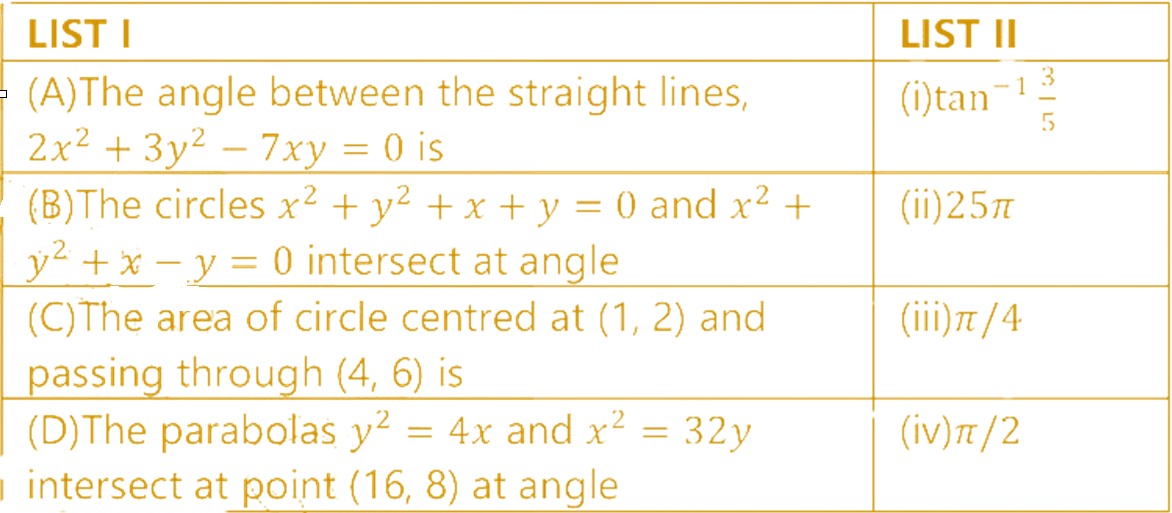
Select Correct Matching
View Dynamic Solution & Explanation ▼
Step-by-step Solution:
(A) The angle between the straight lines \(2x^2 + 3y^2 - 7xy = 0\) is: The given equation represents a pair of straight lines. The angle \(\theta\) between two lines represented by the equation \(ax^2 + 2hxy + by^2 = 0\) is given by: \[ \tan\theta = \frac{2\sqrt{h^2 - ab}}{a + b} \] For the equation \(2x^2 + 3y^2 - 7xy = 0\), we have: - \(a = 2\), - \(b = 3\), - \(h = -\frac{7}{2}\). Substituting these values: \[ \tan\theta = \frac{2\sqrt{\left(-\frac{7}{2}\right)^2 - (2)(3)}}{2 + 3} = \frac{2\sqrt{\frac{49}{4} - 6}}{5} = \frac{2\sqrt{\frac{25}{4}}}{5} = \frac{2 \cdot \frac{5}{2}}{5} = 1 \] Thus, \(\theta = \tan^{-1}(1) = \frac{\pi}{4}\). Match: (A) \(\rightarrow\) (iii) \(\frac{\pi}{4}\) --- (B) The circles \(x^2 + y^2 + x + y = 0\) and \(x^2 + y^2 + x - y = 0\) intersect at angle: The angle of intersection between two circles is given by: \[ \cos\theta = \frac{r_1^2 + r_2^2 - d^2}{2r_1r_2} \] For the first circle \(x^2 + y^2 + x + y = 0\): - Center \(C_1 = \left(-\frac{1}{2}, -\frac{1}{2}\right)\), - Radius \(r_1 = \sqrt{\left(\frac{1}{2}\right)^2 + \left(\frac{1}{2}\right)^2} = \frac{\sqrt{2}}{2}\). For the second circle \(x^2 + y^2 + x - y = 0\): - Center \(C_2 = \left(-\frac{1}{2}, \frac{1}{2}\right)\), - Radius \(r_2 = \sqrt{\left(\frac{1}{2}\right)^2 + \left(-\frac{1}{2}\right)^2} = \frac{\sqrt{2}}{2}\). The distance between centers \(C_1\) and \(C_2\) is: \[ d = \sqrt{\left(-\frac{1}{2} - \left(-\frac{1}{2}\right)\right)^2 + \left(-\frac{1}{2} - \frac{1}{2}\right)^2} = \sqrt{0 + 1} = 1 \] Substituting into the formula: \[ \cos\theta = \frac{\left(\frac{\sqrt{2}}{2}\right)^2 + \left(\frac{\sqrt{2}}{2}\right)^2 - 1^2}{2 \cdot \frac{\sqrt{2}}{2} \cdot \frac{\sqrt{2}}{2}} = \frac{\frac{1}{2} + \frac{1}{2} - 1}{1} = 0 \] Thus, \(\theta = \frac{\pi}{2}\). Match: (B) \(\rightarrow\) (iv) \(\frac{\pi}{2}\) --- (C) The area of the circle centered at (1, 2) and passing through (4, 6) is: The radius \(r\) of the circle is the distance between the center \((1, 2)\) and the point \((4, 6)\): \[ r = \sqrt{(4 - 1)^2 + (6 - 2)^2} = \sqrt{9 + 16} = 5 \] The area of the circle is: \[ \text{Area} = \pi r^2 = \pi (5)^2 = 25\pi \] Match: (C) \(\rightarrow\) (ii) \(25\pi\) --- (D) The parabolas \(y^2 = 4x\) and \(x^2 = 32y\) intersect at point (16, 8) at angle: The angle between two curves at their point of intersection is the angle between their tangents at that point. 1. For \(y^2 = 4x\), the derivative is: \[ 2y \frac{dy}{dx} = 4 \implies \frac{dy}{dx} = \frac{2}{y} \] At \((16, 8)\), the slope \(m_1 = \frac{2}{8} = \frac{1}{4}\). 2. For \(x^2 = 32y\), the derivative is: \[ 2x = 32 \frac{dy}{dx} \implies \frac{dy}{dx} = \frac{x}{16} \] At \((16, 8)\), the slope \(m_2 = \frac{16}{16} = 1\). The angle \(\theta\) between the two curves is: \[ \tan\theta = \left|\frac{m_2 - m_1}{1 + m_1m_2}\right| = \left|\frac{1 - \frac{1}{4}}{1 + \frac{1}{4} \cdot 1}\right| = \left|\frac{\frac{3}{4}}{\frac{5}{4}}\right| = \frac{3}{5} \] Thus, \(\theta = \tan^{-1}\left(\frac{3}{5}\right)\). Match: (D) \(\rightarrow\) (i) \(\tan^{-1}\frac{3}{5}\) --- Final Matching: - (A) \(\rightarrow\) (iii) \(\frac{\pi}{4}\) - (B) \(\rightarrow\) (iv) \(\frac{\pi}{2}\) - (C) \(\rightarrow\) (ii) \(25\pi\) - (D) \(\rightarrow\) (i) \(\tan^{-1}\frac{3}{5}\)