Question 41
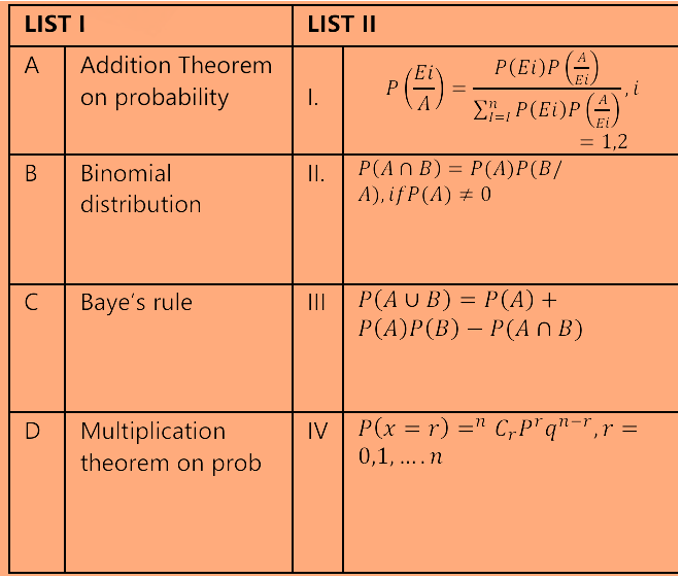
Match List I With List II
View Dynamic Solution & Explanation ▼
Step-by-step Solution:
(A) Addition Theorem on Probability: The addition theorem on probability states that for any two events \(A\) and \(B\): \[ P(A \cup B) = P(A) + P(B) - P(A \cap B) \] This matches with LIST II (III). Match: (A) \(\rightarrow\) (III) --- (B) Binomial Distribution: The probability mass function of a binomial distribution is given by: \[ P(X = r) = \binom{n}{r} p^r q^{n-r}, \quad r = 0, 1, \dots, n \] This matches with LIST II (IV). Match: (B) \(\rightarrow\) (IV) --- (C) Baye's Rule: Baye's rule (or Bayes' theorem) is given by: \[ P\left(\frac{E_i}{A}\right) = \frac{P(E_i) P\left(\frac{A}{E_i}\right)}{\sum_{i=1}^{n} P(E_i) P\left(\frac{A}{E_i}\right)}, \quad i = 1, 2, \dots, n \] This matches with LIST II (I). Match: (C) \(\rightarrow\) (I) --- (D) Multiplication Theorem on Probability: The multiplication theorem on probability states that for two events \(A\) and \(B\): \[ P(A \cap B) = P(A) P\left(\frac{B}{A}\right), \quad \text{if } P(A) \neq 0 \] This matches with LIST II (II). Match: (D) \(\rightarrow\) (II) --- Final Matching: - (A) \(\rightarrow\) (III) - (B) \(\rightarrow\) (IV) - (C) \(\rightarrow\) (I) - (D) \(\rightarrow\) (II)