Question 49
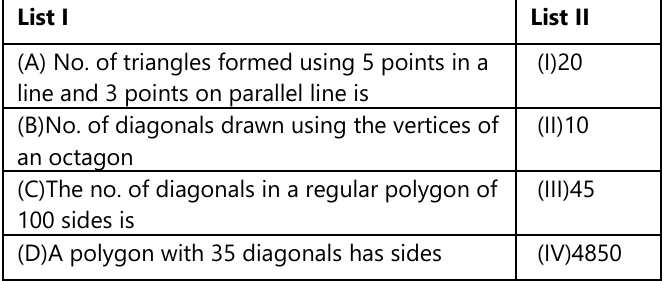
Match List I with List II-
View Dynamic Solution & Explanation ▼
Step-by-step Solution:
(A) Number of triangles formed using 5 points in a line and 3 points on a parallel line To form a triangle, we need to choose 3 points such that they are not collinear. 1. The total number of ways to select 3 points from the 8 points (5 on one line + 3 on the other) is: \[ \text{Total selections} = \binom{8}{3} = \frac{8!}{3!(8-3)!} = \frac{8 \times 7 \times 6}{3 \times 2 \times 1} = 56 \] 2. However, the cases where all 3 points lie on the same line do not form a valid triangle. - Choosing 3 points from the 5 points on the first line: \[ \binom{5}{3} = \frac{5!}{3!(5-3)!} = \frac{5 \times 4}{2 \times 1} = 10 \] - Choosing 3 points from the 3 points on the second line: \[ \binom{3}{3} = 1 \] 3. Subtracting these cases: \[ 56 - (10 + 1) = 45 \] Thus, the correct match for (A) is not 20. There might be an issue with the given options. (B) Number of diagonals drawn using the vertices of an octagon The formula for the number of diagonals in an \( n \)-sided polygon is: \[ D = \frac{n(n-3)}{2} \] For an octagon (\( n = 8 \)): \[ D = \frac{8(8-3)}{2} = \frac{8 \times 5}{2} = 20 \] So, the correct match for (B) is (I) 20. (C) Number of diagonals in a 100-sided polygon Using the same formula: \[ D = \frac{100(100-3)}{2} = \frac{100 \times 97}{2} = \frac{9700}{2} = 4850 \] So, the correct match for (C) is (IV) 4850. (D) A polygon with 35 diagonals has how many sides? We solve for \( n \) using the diagonal formula: \[ \frac{n(n-3)}{2} = 35 \] Multiplying both sides by 2: \[ n(n-3) = 70 \] Solving \( n^2 - 3n - 70 = 0 \) using the quadratic formula: \[ n = \frac{-(-3) \pm \sqrt{(-3)^2 - 4(1)(-70)}}{2(1)} \] \[ n = \frac{3 \pm \sqrt{9 + 280}}{2} \] \[ n = \frac{3 \pm \sqrt{289}}{2} \] \[ n = \frac{3 \pm 17}{2} \] \[ n = \frac{20}{2} = 10 \quad \text{or} \quad n = \frac{-14}{2} = -7 \] Since \( n \) must be positive, we take \( n = 10 \). So, the correct match for (D) is (II) 10. Final Matching (A) Number of triangles → ( should be 45) (B) Number of diagonals in an octagon → (I) 20 (C) Number of diagonals in a 100-sided polygon → (IV) 4850 (D) A polygon with 35 diagonals has sides → (II) 10 Thus, the correct matching is: \[ (A) \to \text{(III) 45}, \quad (B) \to \text{(I) 20}, \quad (C) \to \text{(IV) 4850}, \quad (D) \to \text{(II) 10} \]