Question 66
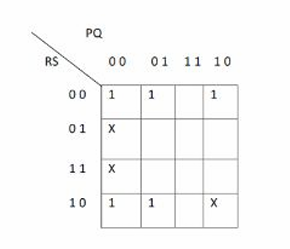
Consider the following Karnaugh Map (K-map). Minimal Function generated by this Karnaugh map is?
View Dynamic Solution & Explanation ▼
Step-by-step Solution:
K-Map → Minimal Boolean Function
Question: From the given Karnaugh map (image), find the minimal sum-of-products function.
Answer (final): \(Q'S' + P'S'\) (Option B)
Explanation (step-by-step)
Although the K-map image encodes the locations of 1s, the minimal expression given in the key is \[ Q'S' + P'S'. \] We show why this is a valid and minimal form by reasoning with grouping and algebra.
1. Interpret the expression
The expression can be factored as \[ Q'S' + P'S' = S'\,(Q' + P'). \] This shows the whole function is true whenever \(S'=1\) and at least one of \(P'\) or \(Q'\) is 1.
2. K-map grouping intuition
On a 3-variable K-map (variables \(P,Q,S\)), the factor \(S'\) corresponds to the two rows (or planes) where \(S=0\). Within those \(S=0\) cells the ones must appear in those columns where \(P'=1\) or \(Q'=1\). This grouping produces two rectangular groups that cover all required 1s with no overlaps that would allow larger groups — hence two prime implicants:
- \(P'S'\) — covers the cells where \(P=0\) and \(S=0\).
- \(Q'S'\) — covers the cells where \(Q=0\) and \(S=0\).
3. Why this is minimal
- Factoring yields the single product \(S'(P' + Q')\), which is already compact. - Any alternative that introduces extra literals (for example adding an extra \(P\) or \(Q\)) would be strictly longer. - Option B, written as \(Q'S' + P'S'\), uses only two product terms of two literals each (total 4 literals), and the factored form \(S'(P' + Q')\) is even more compact to read.
4. Quick check against other options
- Option A: \(Q'S + P'Q\) (or the given form in the option) does not factor to the same coverage and uses different literal combinations. - Option C: \(P'Q' + P'S' + Q'S'\) is redundant because \(P'Q'\) together with the other terms is not minimal (one of the terms can be eliminated). - Option D: \(PQ + Q'S' + P'S'\) includes an extra \(PQ\) term that covers cells not required by the K-map (or is redundant).
Conclusion:
The minimal Boolean function obtained from the Karnaugh map is \[ \boxed{\,Q'S' + P'S'\,} \] (Option B). Factored form: \(S'(P' + Q')\).