Question 5

Mathematics Probability Easy

Let \( E^{c} \) denote the complement of an event \( E \) . Let \( E, F, G \) be pairwise independent events with \( P(G)>0 \) and \( P(E \cap F \cap G)=0 \) . The \( P\left(E^{c} \cap F^{c} \cap \mid G\right) \) equals

(A) \( P\left(E^{c}\right)+P\left(F^{c}\right) \)
(B) \( \mathrm{P}\left(\mathrm{E}^{\mathrm{c}}\right)-\mathrm{P}\left(\mathrm{F}^{\mathrm{c}}\right) \)
(C) \( \mathrm{P}\left(\mathrm{E}^{\mathrm{C}}\right)-\mathrm{P}(\mathrm{F}) \)
(D) \( P(E)-P\left(F^{c}\right) \)
✓ Correct Answer: Option C Verified Solution

📘 Step-by-Step Solution & Detailed Explanation:

We have \[ E \cap F \cap G = \emptyset \] \[ P(E^c \cap F^c \mid G) = \frac{P(E^c \cap F^c \cap G)}{P(G)} \] \[ = \frac{P(G) - P(E \cap G) - P(G \cap F)}{P(G)} \] From the Venn diagram: \[ E^c \cap F^c \cap G = G - E \cap G - F \cap G \] \[ = \frac{P(G) - P(E) P(G) - P(G) P(F)}{P(G)} \] (Since \(E, F, G\) are pairwise independent) \[ = 1 - P(E) - P(F) = P(E^c) - P(F) \]
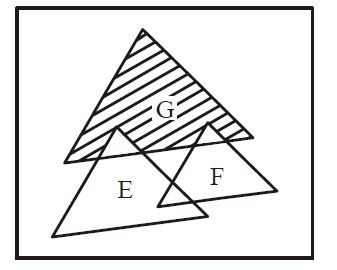
Solution Explanation Image

Practice Similar Probability Questions

Reinforce your conceptual grasp with related questions from MAH MCA CET 2024:

Q2 In a multiple choice question, there are four alternative answers, of...
Solve →
Q11 Suppose two cards are drawn at random from a deck of cards, Let \( X \) be...
Solve →
Q17 If the Probability Density Function of a continuous random variable \( X...
Solve →
Q18 An experiement has 10 equally likely outcomes. Let \( A \) and \( B \) be...
Solve →
Q22 Cumulative Density Function \( F(x) \) of a continuous random variable X...
Solve →
Full-Length Test Series

Prepare for MAH MCA CET Under Real Exam Conditions

Take timed full-length mock tests with authentic question distributions, negative marking (+12/-3 in Math), and instant All India Rank calculation.

Start Free Mock Test Series →