Question 73
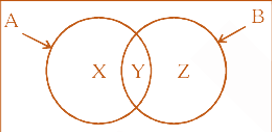
Consider the diagram given below and the following two statements:
In the light of the above statements, choose the most appropriate answer from the options given below:
View Dynamic Solution & Explanation ▼
Step-by-step Solution:
Statement I: Expressing Regions \(X, Y, Z\) in Set Notation From the given Venn diagram: - \( X \) is the part of \( A \) that is not in \( B \), i.e., \[ X = A \cap \bar{B} \] - \( Y \) is the part of both \( A \) and \( B \), i.e., \[ Y = A \cap B \] - \( Z \) is the part of \( B \) that is not in \( A \), i.e., \[ Z = \bar{A} \cap B \] Thus, Statement I is true. Statement II: Probability Expressions Using set notation and probability properties: - The total probability of \( A \) is the sum of the probabilities of regions \( X \) and \( Y \), i.e., \[ P(A) = P(X) + P(Y) \] Rearranging: \[ P(Y) = P(A) - P(X) \] - Similarly, the total probability of \( B \) is the sum of the probabilities of regions \( Y \) and \( Z \), i.e., \[ P(B) = P(Y) + P(Z) \] Rearranging: \[ P(Y) = P(B) - P(Z) \] Thus, the given probability equations are correct, and Statement II is true. Final Answer: Since both Statement I and Statement II are true, the correct option is: \[ \boxed{\text{A. Both Statement I and Statement II are true.}} \]