Question 2
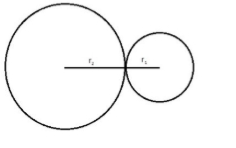
Two circles touch externally. The sum of their areas is 130π sq. cm and the distance between their centres is 14 cm. Find the radii of the circles.
View Dynamic Solution & Explanation ▼
Step-by-step Solution:
Let the radii of the two circles be \(r_1\) and \(r_2\).
1. Formulate equations from the given information:
The sum of the areas is given as \(130\pi\) sq. cm.
The area of a circle is \(\pi r^2\).
\[\pi r_1^2 + \pi r_2^2 = 130\pi\]
Dividing the entire equation by \(\pi\), we get our first equation:
\[r_1^2 + r_2^2 = 130 \quad \cdots(1)\]
Since the two circles touch externally, the distance between their centers is the sum of their radii.
\[r_1 + r_2 = 14 \quad \cdots(2)\]
2. Solve the system of equations:
We can use the algebraic identity \((a+b)^2 = a^2+b^2+2ab\).
Substitute the values from equations (1) and (2) into this identity:
\[\begin{aligned} (r_1 + r_2)^2 &= (r_1^2 + r_2^2) + 2r_1r_2 \\ (14)^2 &= 130 + 2r_1r_2 \\ 196 &= 130 + 2r_1r_2 \\ 196 - 130 &= 2r_1r_2 \\ 66 &= 2r_1r_2 \\ r_1r_2 &= 33 \end{aligned}\]
3. Find the radii by forming a quadratic equation:
We now know the sum of the radii (\(r_1+r_2=14\)) and the product of the radii (\(r_1r_2=33\)). The radii are the roots of the quadratic equation \(x^2 - (\text{sum of roots})x + (\text{product of roots}) = 0\).
\[x^2 - 14x + 33 = 0\]
Factoring the equation:
\[(x - 11)(x - 3) = 0\]
The roots are \(x=11\) and \(x=3\).
Result:
The radii of the two circles are 11 cm and 3 cm.