Question 3
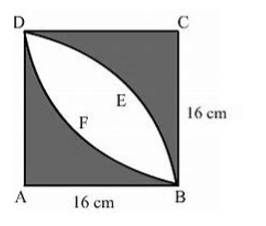
Calculate the area other than the area common between two quadrants of circles of radius 16 cm each, which is shown as the shaded region in the figure given.
View Dynamic Solution & Explanation ▼
Step-by-step Solution:
The shaded region is the area of the square minus the area of the unshaded, leaf-shaped region common to both quadrants.
Let \(r\) be the radius of the quadrants, which is also the side of the square. Given \(r = 16\) cm.
1. Find the Area of the Unshaded (Leaf-shaped) Region:
The sum of the areas of the two quadrants covers the entire square, but it double-counts the central leaf-shaped region. This can be expressed as:
\(A_{\text{Quadrant 1}} + A_{\text{Quadrant 2}} = A_{\text{Square}} + A_{\text{Leaf}}\).
Rearranging this to solve for the area of the leaf gives:
\[A_{\text{Leaf}} = (A_{\text{Quadrant 1}} + A_{\text{Quadrant 2}}) - A_{\text{Square}}\]
First, calculate the component areas:
\[A_{\text{Square}} = r^2 = 16^2 = 256 \text{ cm}^2\]\[A_{\text{one quadrant}} = \frac{1}{4}\pi r^2 = \frac{1}{4}\pi (16)^2 = 64\pi \text{ cm}^2\]
Now, find the area of the leaf:
\[A_{\text{Leaf}} = (64\pi + 64\pi) - 256 = (128\pi - 256) \text{ cm}^2\]
2. Find the Area of the Shaded Region:
The shaded area is the area of the square minus the area of the leaf.
\[\begin{aligned} A_{\text{Shaded}} &= A_{\text{Square}} - A_{\text{Leaf}} \\ &= 256 - (128\pi - 256) \\ &= 256 - 128\pi + 256 \\ &= 512 - 128\pi \end{aligned}\]
Now, substitute \(\pi \approx \frac{22}{7}\):
\[\begin{aligned} A_{\text{Shaded}} &= 512 - 128 \left(\frac{22}{7}\right) \\ &= 512 - \frac{2816}{7} \\ &= 512 - 402.2857... \\ &\approx 109.7143 \text{ cm}^2 \end{aligned}\]
Result:
The area of the shaded region is approximately \(109.72 \text{ cm}^2\).